
I know you have biases.
(Ooft, strong opening sentence. Very, "I know what you did last summer".)
This isn't slander, though, or a subtle hint at my secret telepathy powers. It's simply a statement of fact. We all have biases, it's part of being a human. You and I are both navigating an increasingly complex social world with a brain designed to eat berries in a cave.
So what do I mean when I say we all have biases? Does this make us all bigots? Let's talk about how can we avoid one becoming the other.
This is a pretty long post but I promise it's filled with juicy science, evolutionary psychology, and (obviously) my signature wit and humour... I hope you stick around til the end.
Content note: This post contains multiple references to prejudice, including racial prejudice, and a lot of snakes.
Why do we have biases?
Meet Sharon and Carl
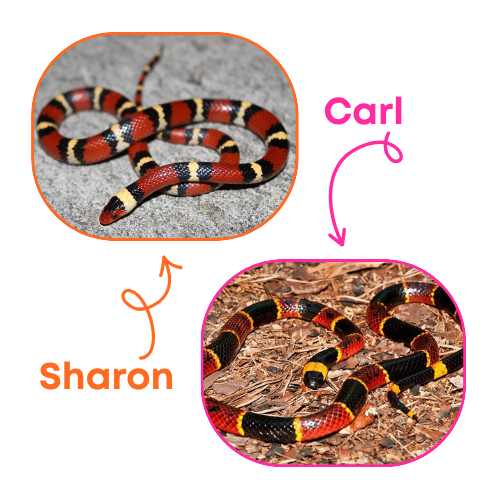
These scaly friends have a secret: one of them is venomous, and the other is completely harmless. But which snake is which?
Spoiler alert - Carl the Coral Snake is the venomous one - he packs a powerful punch of neurotoxins which could definitely kill you. Sharon is a Scarlet King Snake, who does his best to look threatening but is actually a big baby. Need a handy rhyme to help you remember the difference? Way ahead of you. "Red touching yellow kills a fellow".
Unfortunately, when our simian ancestors came across a snake out in the jungle, they didn't have this handy phrase. If I came across a snake like this, I'd probably forget the cutesy rhyme and just get the heck out of there - most of us would. And that's where a bit of evolutionary psychology comes in.
Evolutionary psychology
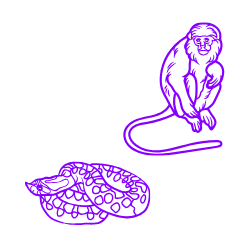
Evolutionary psychology explains that the pre-humans who instinctively avoided snakes hung around the planet a lot longer than those who gave snakes the benefit of the doubt. They passed on their tendency toward snake-fearing to their offspring, and (over millions of years) an innate anti-snake bias was formed. Present-day humans still have this bias, with many studies showing that fear of snakes is far more common than the fear of (for example) flowers.
We can use this same logic to explain fear of heights, and the human tendency toward fearing things that are different. If we don't recognise something as similar to us, it is much more likely to be dangerous.
Neurology of bias
Countless neurological studies have focused on the amygdalae (plural of amygdala) - the parts of our brain involved in fear responses. Many of these studies have found that the amygdalae activate more strongly on scans when we're presented with a face of a different race to us than a face of our own ethnicity. This happens even if those images are shown too briefly for us to even consciously recognise that we've seen them (though this is complex - there's a good review of the research here, if you're interested).
The research also shows a strong link between our unconscious bias scores (as measured by the Harvard Implicit Associations Tests which are freely available for anyone to do, hint hint 👀) and how much our amygdala activates when seeing faces of other races.
Nature or nurture?
Children show a preference for faces of the same race as them, but, importantly, this can be changed by experience and positive exposure to people of other races. Similarly, our unconscious bias influences how trustworthy we think other-race faces are, but this can also be changed by experience and exposure (Cheung et al., 2024). This shows that we are not doomed by or bound to our biases - we can do something about them!
There are more explanations for why we have biases, such as our limitations for information processing.
Information processing
Our brains receive 11 million bits of information at any one time, but we can only consciously process about 40 bits. This means that 99.999996% of what we process about the world is done unconsciously - without our awareness, direction, or control.
Our brains can only process so much information because of schemas, which are basically "rules of thumb" that help us organise information into categories. Stereotypes are a form of schema, allowing for quick and automatic categorisation... and, unfortunately, bias.
So that's a really quick overview of some of the scientific thinking surrounding bias, but there is so much more to explore, like the role of our environments, learning, and the entire world of cognitive biases. More on that another time - let's get back to the title of this email: do your biases make you a bigot?
Bias vs. bigotry
A bias is an “inclination or prejudice for or against one person or group”, whereas bigotry is when someone is “obstinately or intolerantly devoted to [their] own opinions and prejudices”.
The difference between these two dictionary definitions is all about inflexibility, and an unwillingness to learn or change your mind.
This is what defines bigotry.
It isn't our first thoughts (those automatic ones, often dictated by bias, social messaging, and assumptions) which define us. It's our second thoughts, our re-evaluation of situations and our own beliefs, and the subsequent actions we take which answer this question.
So let’s get into that.
Tips for tackling personal bias
We've all got a responsibility to make sure that our own personal biases aren't negatively impacting upon others, so here are a few key tips to help you do that:
Do the Harvard Implicit Associations Tests. No, really - do 'em. They're super quick and basically a game that gives you insight into your biases for or against certain groups. I really recommend this as a first step to making the unconscious more conscious.
Pay attention to your first thoughts, and greet them with curiosity. Why is it that your automatic reaction is to judge, or make assumptions? What is your second thought, and how can we build that into positive action?
Challenge your schemas and stereotypes. Social media is so helpful for this - think about who you follow and whether they're all the same in terms of identity, experience, and perspective. What groups of people are you forgetting? Do you follow any disabled people who educate on disability (for example)?
Build in checks and balances. Have people check your work for bias, work in teams, question your assumptions and decisions (and objectively justify them to yourself and others).
Learn from mistakes. We all make assumptions, but are we going to notice them and use them to grow, or are we going to sit comfortably with our biases, displaying that inflexibility and unwillingness to learn that defines bigotry? The choice is yours, after all!
Doing DEIA differently
So often when we talk about bias, it's framed like an accusation. I think that's counter-productive - it gets people defensive and inflexible, which pushes them closer to that 'bigotry' definition.
If we approach bias as a biological fact we remove the shame and stigma associated with having biases. This enables open conversations, and allows people to self-reflect, learn, and grow.
Admitting that we all have biases is a brave step to take, especially being open about the steps you are taking to confront and tackle your own. It also makes you someone who leads by example, and allows people the space to realise that bias does not equal bad person. In fact, bias equals human. It's what we choose to do about it that makes all the difference.
Services Spotlight
Unconscious Bias Training
Session overview:
We all have biases. They affect our thoughts, our behaviours, and how we perceive the world. They’re present in our work, and can lead to the unfair treatment of others. So what is a bias, and how can we rewire our brains to view the world more objectively? We’ll explore the science behind bias, from anthropology through to cutting edge neurological research. This highly interactive session helps participants to view their own biases through a lens of curiosity, not shame, facilitating open discussion about how our biases shape our thoughts, language, and actions.
Recommended session length: 2.5 hours
Key learning outcomes:
Understand what bias is, and what makes a bias conscious or unconscious
Understand what a cognitive bias is, and recognise some key types
Understand the science behind bias
Understand how to recognise and counter bias
Best practice tips
If you would like to combine this session with the Microaggressions or Inclusive Recruitment training sessions, a discount is available when booked together
Please request my Training Brochure to find out more about my training approach and standard sessions. If you're looking for something bespoke, just get in touch!
Free Disco Call
Fancy a free 30-minute discovery call to discuss how I can help you to amplify your inclusion work? Click the chirpy little button below to view my availability and book a slot that works for you